
Shark Lab Deploys Drone Surveillance System
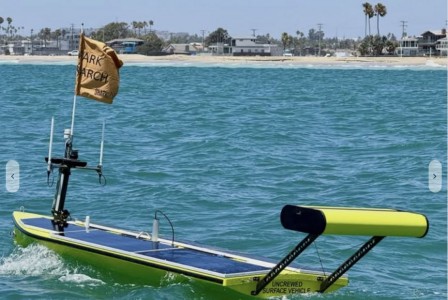
For decades, scientists at California State University, Long Beach's Shark Lab have studied the movements of sharks and other marine life along Southern California's coastline. Now, the lab is taking that research a step further with a prototype semi-autonomous shark detection system designed to help lifeguards detect sharks in real time while improving public safety.
Funded by the Seavers Institute in collaboration with the New York University Center of Robotics and the Monterey Bay Aquarium Research Institute, Shark Lab debuted the prototype in late July. Scientists at Shark Lab conceived the prototype as a means of improving their overall operations, while cutting down on the immense number of resources the lab needs to conduct those operations.
“We have shark-monitoring equipment scattered across the coast, and it costs the lab millions of dollars a year to maintain that operation,” said CSULB Shark Lab Director Dr. Chris Lowe. “The idea is if, for example, we cannot cover a beach due to lack of available resources, they could have this boat patrolling off their beach and it would give them all the monitoring tools they would need at one beach.”
According to Lowe, the prototype would also act as a great surveillance tool for lifeguards, in the event the drone detects any tagged shark swimming in the water, it would then send that data to lifeguards in the area through an alert system.
When asked how the prototype would distinguish a shark from other marine life such as dolphins or seals, Lowe explained that the semi-autonomous boat, once fully complete, will include an aerial drone stationed on the back of the boat, and will be capable of streaming live footage back to lifeguards while being remotely controlled.
“If the aerial drone sees a shark in the water, it will stream back videos to us and to the lifeguards,” said Lowe. “From there, we can make some assessment and then tell the boat to go to it [the aerial drone] so that it can land back in its box and recharge itself.”
Lowe continued: “The prototype is a multi-surveillance tool that combines all the things we [Shark Lab] do along the coast, but it can be patrolling off a single beach and give lifeguards real-time streaming data.”
Currently, most of the sharks that are tagged and tracked by Shark Lab are great white sharks. Lowe explained that this is due to great whites being responsible for a majority of shark-related injuries in the state. According to a study done by the California Department of Fish & Wildlife, there have been about 200 shark incidents in California waters between January 1950 and December 2021; 107 of those injuries being non-fatal, and 15 that were fatal.
“Lifeguards are most concerned about white shark activity off beaches,” said Lowe. “The more information they have, the better they can manage their beaches.”
In addition to their plans to further advance shark monitoring technology, Dr. Chris Lowe and the rest of Shark Lab hope to have a fully operational version of the shark-surveillance drone ready by 2028, just ahead of the upcoming Olympic Games, as surfing and other water competitions will be held off the coast of California.
“Being able to do monitoring with the drone would help keep athletes safe or at least advise lifeguards how much shark activity there is during competitions,” said Lowe.
For more information on CSULB’s Shark Lab, you can visit their official website at https://www.csulb.edu/shark-lab.
Category:
- Log in to post comments
Featured Video
Beachcomber
Copyright 2026 Beeler & Associates.
All rights reserved. Contents may not be reproduced or transmitted – by any means – without publisher's written permission.

